Tag "research projects"

HSE FCS Researchers Showcase AI and Bioinformatics Breakthroughs at ICLR 2026

HSE FCS Researchers Showcase AI and Bioinformatics Breakthroughs at ICLR 2026
Researchers from the AI and Digital Science Institute at the HSE Faculty of Computer Science, along with students from the AI360: Artificial Intelligence Engineering track of the Applied Mathematics and Information Science bachelor’s programme, took part in ICLR, one of the world’s most prestigious international conferences on machine learning and representation learning. This year’s event was held in Rio de Janeiro, Brazil.

HSE University Presents Research Results at AI Conference in Oman

HSE University Presents Research Results at AI Conference in Oman
In April 2026, the International Conference on Intelligent Systems and Artificial Intelligence Applications (ISAA 2026) was held at the University of Nizwa in the Sultanate of Oman. The event was co-organised by HSE University, the University of Nizwa, and the University of Technology and Applied Sciences–Ibri. Researchers from HSE University were among the key speakers at the conference.

‘HSE Offers a Lot, Not Just Academically, but Also in Terms of Community and Unexpected Opportunities’

Zhou Jinyu
Zhou Jinyu, from China, is a fourth-year student of the Bachelor’s programme ‘Data Science and Business Analytics’ at the HSE University Faculty of Computer Science. On March 5, 2026, Zhou Jinyu delivered the report ‘Exploration of Object-Centric Process Mining Using Object-Centric Sequence Diagrams’ as part of the PAIS Lab seminar. In her interview with the HSE News Service, she spoke on her research topic, how object-centric process mining lets data reflect reality, and her overall experience of studying at HSE University.

Scientists Test Asymmetry Between Matter and Antimatter

Scientists Test Asymmetry Between Matter and Antimatter
An international team, including scientists from HSE University, has collected and analysed data from dozens of experiments on charm mixing—the process in which an unstable charm meson oscillates between its particle and antiparticle states. These oscillations were observed only four times per thousand decays, fully consistent with the predictions of the Standard Model. This indicates that no signs of new physics have yet been detected in these processes, and if unknown particles do exist, they are likely too heavy to be observed with current equipment. The paper has been published in Physical Review D.

AI to Enable Accurate Modelling of Data Storage System Performance

AI to Enable Accurate Modelling of Data Storage System Performance
Researchers at the HSE Faculty of Computer Science have developed a new approach to modelling data storage systems based on generative machine learning models. This approach makes it possible to accurately predict the key performance characteristics of such systems under various conditions. Results have been published in the IEEE Access journal.

Faculty of Computer Science Lab Develops Monitoring System for LHC Experiment

Faculty of Computer Science Lab Develops Monitoring System for LHC Experiment
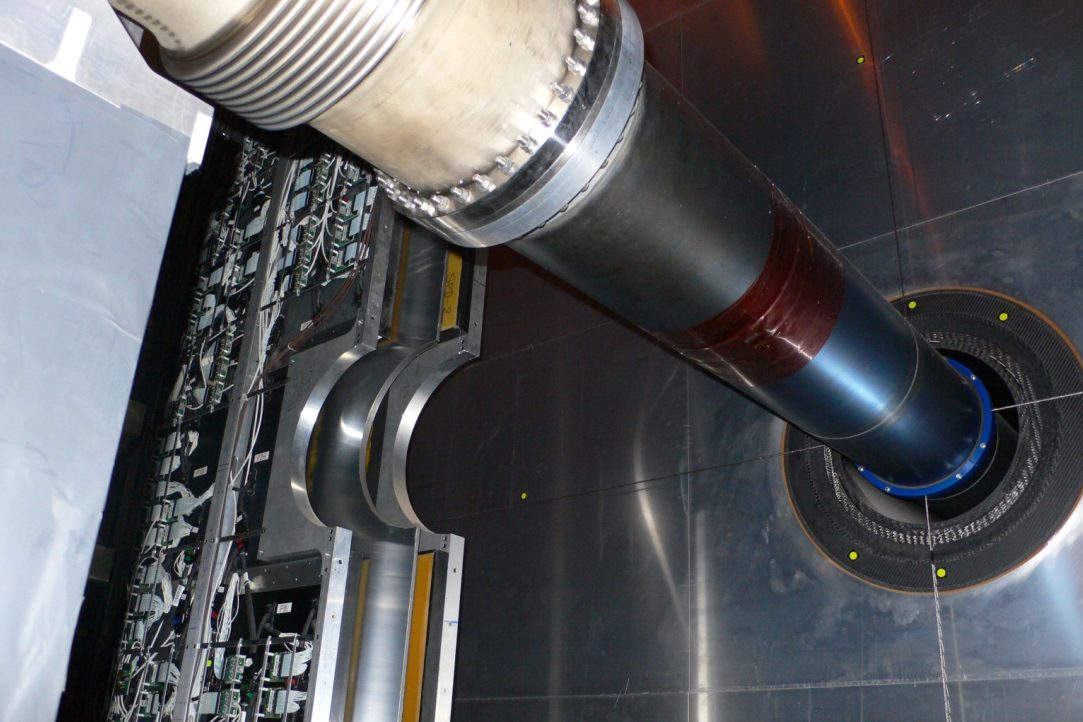
Researchers from the Laboratory of Methods for Big Data Analysis (LAMBDA) at the HSEFaculty of Computer Science have created a monitoring system that is used in the Large Hadron Collider beauty experiment (LHCb). The system helps track the quality of the collected data and allows operators to quickly find errors.

HSE University among Founders of Super C-Tau Factory

HSE University among Founders of Super C-Tau Factory
Ten universities and institutes have announced a partnership to construct an electron-positron collider in order to study the production and properties of charmed particles and tau leptons. The new experiment will be part of the Super C-Tau Factory project. It was founded by two international teams and eight from Russia, including HSE University.